As someone who watched some racing growing up and played some Forza here and there, I thought I knew a thing or two about racing lines when I hopped in a Nissan Sentra in 2021 for my very first autocross run. It turns out the two disciplines reward very different lines, because different physics decides which one is fastest.
The basic equation
Let’s start with some simple math. (Vivek Goel’s content on this topic helped me understand it, as did Ross Bentley’s article Which is faster: a shorter distance or a higher speed through a corner?)
The time it takes to drive any path is the distance divided by speed, added up along the whole path:
where is distance along the path and is your speed at each point. So the question is always the same: compare a longer, wider path (, ) against a shorter, tighter path (, ). For the wider line to be quicker, its percentage gain in speed must exceed its percentage increase in path length.
Steady state: why a bigger arc alone doesn’t pay
For a constant-radius arc of angle (in radians) and radius :
- Path length:
- Grip-limited speed: (ignoring aero and banking)
Doubling the radius () doubles the distance (), while speed only rises by :
Because distance scales linearly with while friction-limited corner speed scales with , a wider arc around the same corner always takes longer than a tighter one.
So where does a wider line ever win? Only when the track lets you increase the radius without adding as much distance, for example by using the full width of the course so your arc isn’t simply a bigger circle around the same apex. To break even, a line that’s 10% longer needs roughly 10% more average speed. Since speed only grows with , that takes about 21% more radius (). That’s a simplified picture, since real corners aren’t constant-radius and aero changes the grip, but it shows the scale of what you’d need.
In most autocross courses, the cones and course width won’t let you open the radius by 21% for only 10% more distance. You might conclude that you should always take the shortest line. But there’s a key question to ask first: what comes after this turn?
What comes after the corner
If you finish a corner and immediately end up in another one, the shorter distance wins, because there’s almost no exit acceleration zone to benefit from. But if you exit onto a stretch where you have some time on the throttle, a different line can be worth it. Especially in higher-horsepower cars, the higher exit speed carries all the way down the straight and can make up a lot of time. That can make a wide entry and exit worth it to keep a higher minimum speed.
We can put numbers on that trade.
1. The debt: time lost in the corner
When you widen your line, your corner distance grows by . Even though your corner speed increases slightly to , the extra distance usually creates a small time penalty:
If is positive, you “owe” time when you exit the turn.
2. The payback: time saved on the straight
On a straight of length , carrying an extra of exit speed reduces your travel time. Using a simple approximation with an average speed down the straight, the time saved is:
3. The break-even: minimum straight length
Setting the payback equal to the debt () gives the minimum straight length that makes the wide line worth it:
This is an optimistic estimate. It assumes you keep the full advantage all the way down the straight. In reality, the car with the higher exit speed accelerates a little more slowly (more drag, and the engine’s available force drops as speed rises), so part of the gap closes. The real break-even straight is somewhat longer than this formula says.
An example from my own data
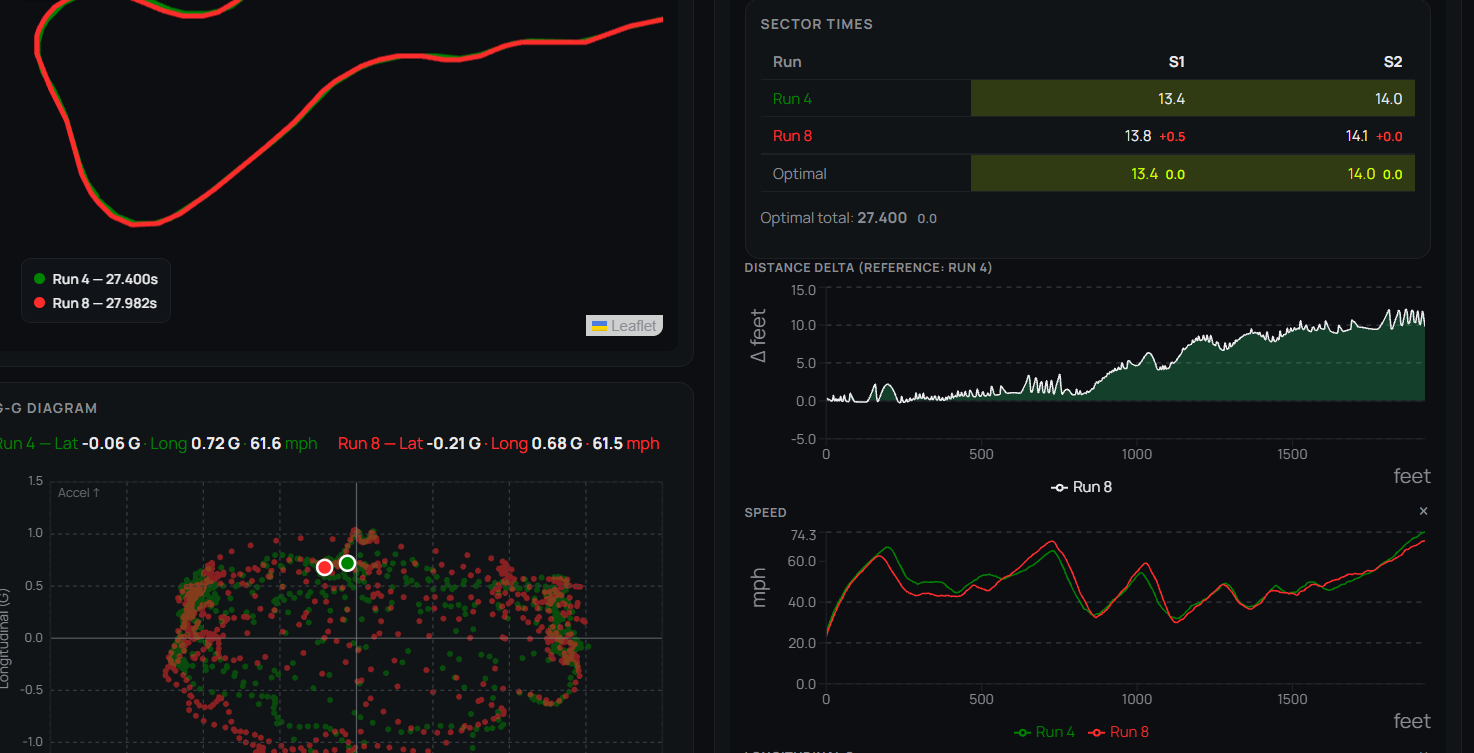
This replay is from the 2026 Toledo ProSolo. It isn’t the most extreme example, but it shows how small nuances add up over a roughly 28-second run. Red is my run (28.144 s), and green is my co-driver’s (28.000 s). He was very good at cutting distance.
Videos play in sync · click to pause
📊 This analysis was done in Autocross Ape, the autocross telemetry tool I built. It’s free to use, and it’s where the course map, time delta, distance delta and speed comparisons above come from. A full tutorial on analyzing your own runs is coming soon.
How to read the data plots, with my co-driver’s run as the baseline:
- Time delta (top): below zero means I’m ahead, above zero means I’m behind.
- Distance delta (middle): above zero means I’ve driven farther than he has.
- Speed (bottom): both runs, red vs green.
Look at the data around the 1,000 to 1,100 ft mark. I braked very late and actually gained about 0.15 s on him, which is the red dip in the time delta. But braking that hard while trying to hold a wide line, I overslowed, because I was trying not to miss the apex. So I carried less minimum speed while also taking a wider line (shame on me), and the gain disappeared almost immediately. By about 1,240 ft I had driven roughly 6.4 ft farther and was 2.4 mph slower (40.0 vs 42.4 mph).
The losses continued into the next corner. I was still fighting the car’s stability, so I couldn’t put the power down as well, and I finished the run 0.14 s behind.
In terms of the break-even formula, I took on all of the “debt” of a wider line (an extra of about 6 ft) and got none of the payback: my was negative. A wide line only makes sense if it actually buys you more minimum and exit speed. Mine bought neither, so the shorter line won.
Takeaways
- The shortest line usually wins in autocross. Corners come back to back, so there’s rarely enough straight to cash in a higher exit speed. Because corner speed only grows with , a bigger arc around the same corner costs more distance than it gains in speed.
- A wider line has to earn its distance. It’s only worth it when it raises your minimum and exit speed, and there’s enough straight afterwards to make that speed pay. The break-even formula gives a quick sanity check, and the real straight needs to be a bit longer than it says.
- Ask “what comes after this turn?” On course walks, look at what follows each corner before choosing a line. A short exit into another corner means take the tight line. A long acceleration zone, especially in a high-power car, means the wider line might be worth it.
- Late braking isn’t the same as being fast. My 0.15 s gain on the brakes was gone a few car lengths later, because it cost me both minimum speed and line.
- Let the data settle the debate. Time delta shows where you lose. Distance delta and speed show why.
Racing games and race-circuit habits taught me to chase the biggest radius. Autocross keeps teaching me that, nine times out of ten, the shortest way around is the fastest way around.